The fastest way to stop clients from quietly disappearing is to read their week rather than ask about it. Assign five habits or fewer, let the client tick them off from their phone, and scan one week of completion on a fixed day, no nightly chasing. Reviewing that record changes outcomes (University of Sheffield, 2016).

The hours you don't see
Say a client trains with you three hours a week. Out of the 168 hours in that week, you are physically present for about 1.8% of it. The other 98.2% happens in a kitchen, a bed, an office chair, a car, and none of it shows up on the program you wrote.
Calling that a motivation problem misreads it. You cannot coach what you cannot see, and visibility is something you can build a system for. Mo walks through the same system out loud in the video above.
There is real evidence behind why watching matters. Prompting people to monitor their own progress toward a goal improves whether they reach it, and the effect gets larger when the record is written down somewhere physical and when someone else sees it (University of Sheffield, 2016). Read that twice. What moves the number is not the client keeping private notes, but keeping a record they know someone will read.
This is why keeping a coach in the loop does something a solo habit app cannot. A habit log nobody reads is a diary. A habit log you scan once a week is coaching.
Across a large body of behavior-change trials, self-monitoring is also the one technique that best explains why some programs work and others do not, and it performs better paired with something else than left alone (University College London, 2009). The something else is a person checking in. That person is you, and a client who quietly stops logging habits is often the same client who is about to stop showing up for workouts. If that pattern already sounds familiar, why personal training clients quit covers the warning signs from the other side, before the cancellation email.
None of this works if habit tracking becomes one more thing you personally chase every night. The next few sections are the operating system: what to assign, how it runs without you, and what a weekly scan actually tells you.
Pick habits your client can still do on their worst week
Five habits, maximum, for any one client. Past five, completion drops and the log stops telling you anything useful.
Every habit on the list should be a behavior, not an outcome. A ten-minute walk is a habit. Losing two pounds is a result, and results belong on the check-in, not the daily log.
The habit also has to survive a bad day. A habit a client cannot do when the day already went wrong is a habit that breaks the streak, and a broken streak is where most people quietly give up on the whole list. Build grace days in on purpose, two missed days a week that do not reset anything. A client who believes one skipped day ruined the entire week is a client who abandons the list altogether, not because the habit failed, but because they think they did.
Let the client pick some of their own habits from a short menu you approve first. Self-selected habits come out stronger than ones a coach hands down cold, and habits practiced in the morning tend to hold better than ones squeezed in late at night (University of South Australia, 2024). Offering a menu costs you nothing and trades a habit the client resents for one they will actually keep doing.
Set it up so nobody gets messaged at 9pm
The whole thing falls over if you are the one sending the reminders. The tracking has to run on its own, and the client has to want to open it without being asked first.
This is where the setup matters as much as the habit list. On Gymkee, a client's habits sit on the home screen of an app they already open to see their program, so logging the day takes seconds and never becomes a separate errand. The streak and the day's record are right there, so the client sees their own progress without you telling them about it. The evening nudge comes from their Gymkee app instead of from you at nine at night, so the reminder still happens and you are not the one sending it.
The two habits clients tend to fudge the most, steps and sleep, sync automatically from the phone, so you are reading a real number instead of a guess. Everything else, water, a mobility drill, a protein target, gets a simple yes or no from the client, which keeps the log fast enough that it actually gets filled in.
On your side, you open one screen and read a week across every client instead of opening each profile one by one. The client habits view and the coach habit tracking dashboard exist for that trade: the client spends a few seconds a day, you spend one short read a week. Old-school coaching apps make you go hunting for what one client did yesterday. This is built to be read at a glance.
If you want to try the setup on your own roster before deciding anything, Gymkee gives you 14 days free, no credit card.
The weekly review that finds the client who is drifting
Here is the arithmetic, and you can redo it with your own client count.
Say you coach 24 clients. If you asked every one of them about their habits every single night, that is 24 times 7, or 168 messages a week. At roughly 30 seconds to write and read each one, you would spend 84 minutes a week just asking questions you could have read the answer to on one screen.
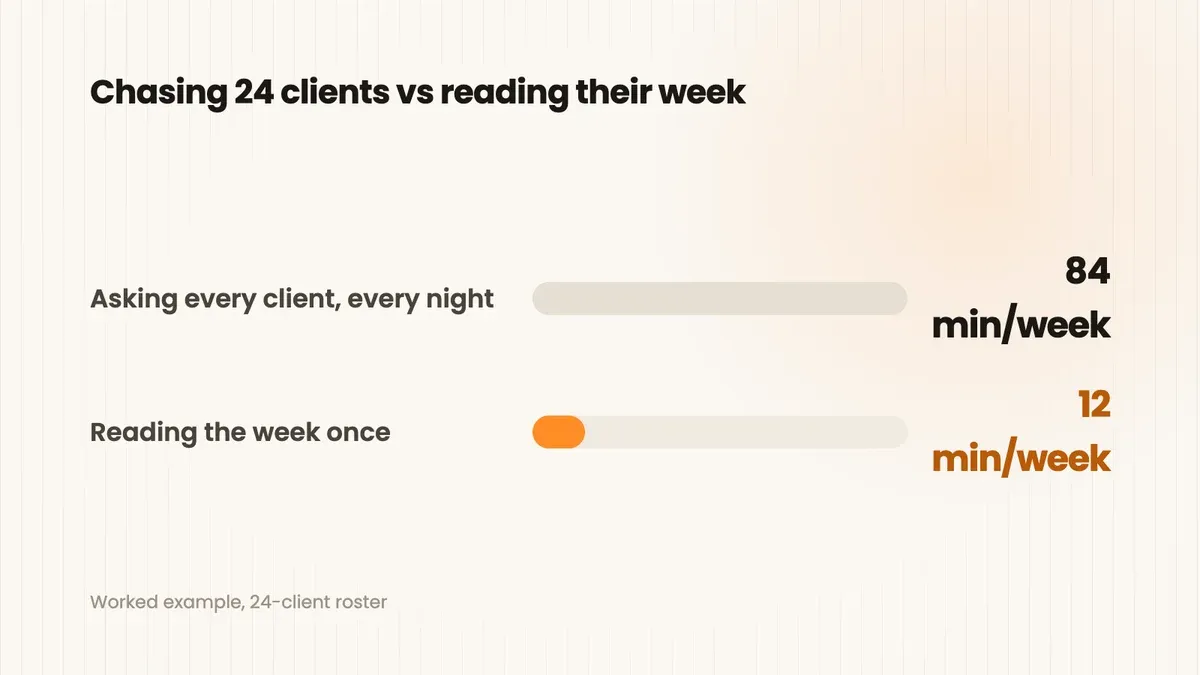
Instead, pick one fixed morning, Monday works well, and read a week of completion for all 24 clients on one screen. At about 30 seconds per client, that comes to 12 minutes, once, for the entire roster. Eighty-four minutes of asking becomes 12 minutes of reading, and the 12 minutes produce a specific sentence instead of a vague one.
What you are reading for is a change in each client's own pattern, not a fixed threshold. Three patterns come up constantly.
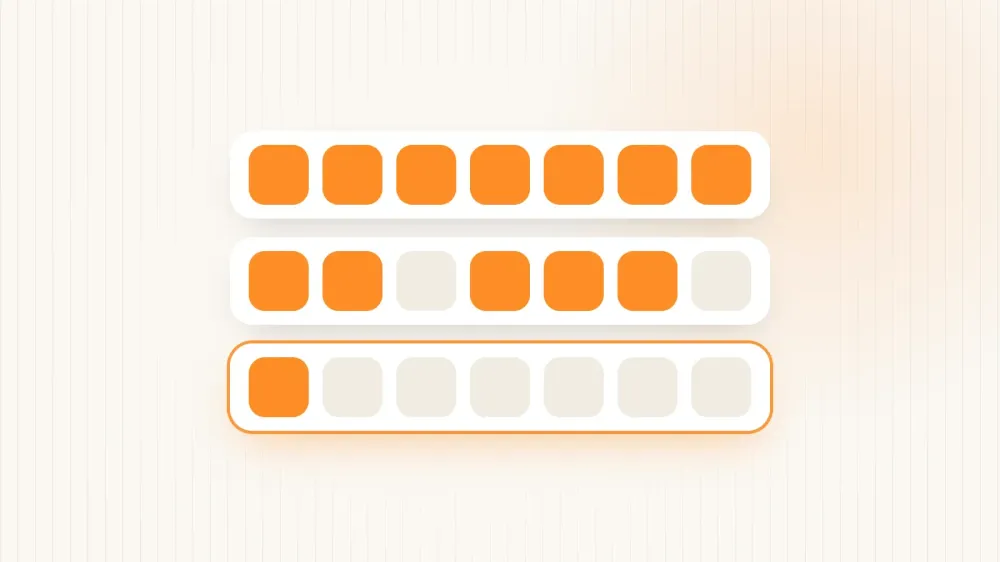
- A week at 90% or better usually means the habits are too easy, or the client is on a good stretch. Leave it alone, and if it holds for three weeks, add one habit.
- A week around 40% means the set is wrong, not the client. Something in it does not survive their actual week. Cut the list to three and ask which one they never manage.
- A week at 0% for a week or more is not a habit problem at all. Ask about the week itself, not about the habits.
That third pattern is the one worth building a routine around, because it is often the earliest signal you get that a client is drifting, sometimes weeks before they say anything or miss a workout. Pair the weekly scan with a short written check-in and you catch it even earlier. A client check-in template built for exactly this handoff saves you writing one from scratch every time.
Three habit sets you can assign today
Start from one of these, then adjust once you see the first week of data.
For general fat loss, five habits work well: a ten-minute walk, a water target logged as yes or no, protein at each meal logged as yes or no, sleep synced automatically, and one no-alcohol day flagged in advance. Nothing on that list requires a gym.
For strength work or a return from a niggle, keep it to four: a five-minute mobility block before training, a pain check-in logged from 0 to 3, steps synced automatically, and a single yes-or-no for rehab work on non-training days. A client managing a knee does not need five more things to think about.
For general accountability, three is enough: sleep synced automatically, one meal logged with a photo, and a single line on how the day felt, on a scale of 1 to 5. This set is for the client who trains hard and shows up, but where you cannot see anything outside the workout. It is often the fastest set to reveal a 40% week, because there is nowhere to hide inside three habits.
Logging frequency itself carries a real, if modest, signal on the outcome clients actually care about. In one weight-loss program, each extra day of food logging in a week was associated with roughly a pound and a half more weight lost over about 20 weeks, though how often people logged was not itself assigned, so the logging cannot be said to have caused the loss (Kaiser Permanente, 2008). Treat the log as a leading indicator, not a scoreboard, and you will read it correctly.
FAQ
How many habits should I give a new client?
Five at most, and fewer for anyone new to tracking. Past five, completion drops and the log stops telling you anything useful. Start a brand-new client on two or three, then add one once those are solid.
What do I do when a client stops logging?
Treat a week at zero as a signal about the week, not about the client's willpower. Ask what happened before you touch the habit list. Most zero weeks trace back to travel, a schedule change, or something outside training entirely, and the fastest way to lose the client is to respond with a lecture about consistency.
How long does it actually take for a habit to stick?
Longer than the popular 21-day figure, and it varies a lot by person. A review pooling 20 studies found a median of roughly two months to form a new habit, with an individual range from 4 days to 335 days, and it explicitly refutes the idea that three weeks is enough (University of South Australia, 2024). Build your habit sets and your grace days around that range, not around 21 days.
Should the client pick their own habits, or should I assign them?
A mix works best. Offer a short menu built around the client's goal, then let them choose which items go on it. Self-selected habits come out stronger than ones handed down without input (University of South Australia, 2024), and a client who picked the habit has a harder time blaming you when they miss it.
Does habit tracking actually change results, or is it just engagement theater?
It changes results when someone reviews the record, which is different from just collecting it. Monitoring progress toward a goal improves the odds of reaching it, and the effect is larger when the record is written down and reported to someone else (University of Sheffield, 2016). Of all the techniques used in behavior-change programs, self-monitoring is the one that best explains why some work and others do not, and it does better paired with at least one other technique than left on its own (University College London, 2009). For a coaching client, that other technique is you, reading the log. Collecting the data is only half of it; the weekly scan is what turns it into a result.