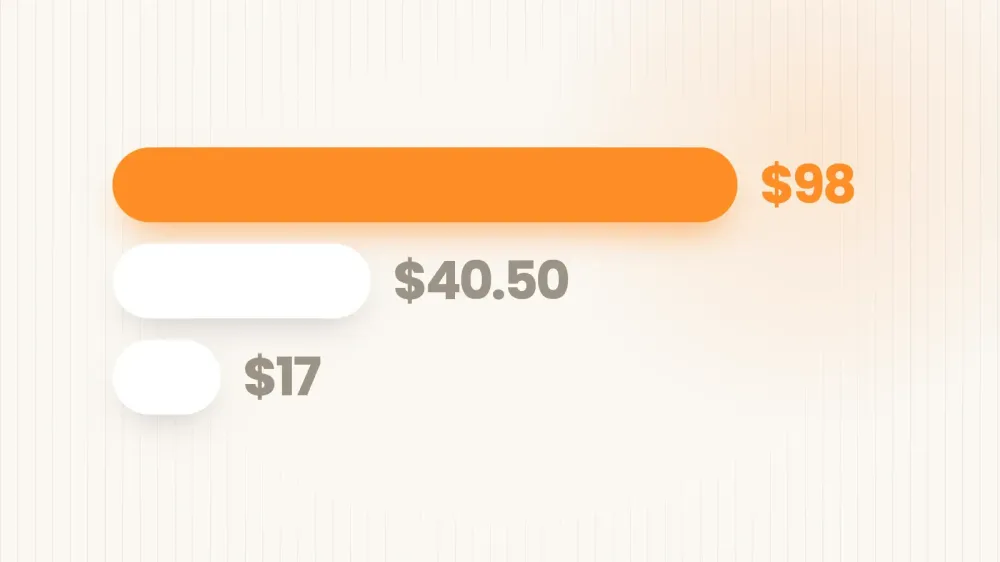
Equinox personal trainers in New York earn $40.50 to $98 per session, plus $17 an hour for floor time (Equinox job posting, 2026). Gold's Gym starts at $25 a session and a Crunch franchise posts up to $63 an hour (franchise postings, 2026). Planet Fitness sells no one-on-one training. The posting shows the session rate; your paycheck is the blend.

How gym chains actually pay trainers
Every chain pays one of four ways, and the structure matters more than the headline number. The first is a session rate plus a floor rate: Equinox and Gold's post two figures, one for the hour you train a member and a much lower one for the hours between clients. The second is a percentage split that rises with the sessions you deliver each month, which is how Crunch franchises work. The third is a flat hourly wage, the YMCA and Anytime Fitness model. The fourth is no training revenue at all, which is Planet Fitness.
Nationally, the median exercise trainer earns $22.67 an hour, or $47,160 a year, and the spread runs from $13.85 an hour at the 10th percentile to $39.95 at the 90th (BLS, May 2025). That spread is mostly these four structures at work, plus how many of your hours actually get billed. Only 28% of trainers work full-time (Insurance Canopy, 2024), so a lot of that median is part-time floor shifts. The video above walks through all four income models; the salary guide covers states and certifications, and this page stays on the chains.
Take a trainer who signs at a Manhattan club in September at $40.50 a session, Tier 1. The first two-week schedule has 72 hours on it. She bills 30 of them. Those 30 sessions pay $1,215. The other 42 hours pay the non-session rate, $17, which is $714. The paycheck is $1,929 for 72 hours, a hair under $27 an hour, because the posting quoted the session rate and said nothing about how many of her hours would be sessions.
Equinox personal trainer salary: the posted range and the floor rate
Equinox posts a full range in every city that requires it, so its numbers are the most reliable on this page. In 2026 its own postings read as follows.
| City | Per session | Non-session hours |
|---|---|---|
| New York (Upper West Side) | $40.50 to $98.00 | $17.00 an hour |
| San Francisco | $40.50 to $72.50 | $19.61 an hour |
| Chicago | $40.50 to $72.50 | $17.05 an hour |
| Los Angeles (Hollywood) | $39.50 to $70.00 | $18.47 an hour |
Every one of those figures comes from an Equinox job posting published between July and August 2026. The New York non-session rate is not a coincidence: $17.00 is the New York City minimum wage as of 1 January 2026 (New York State Department of Labor, 2026). Floor hours at Equinox are paid at the legal floor, and the same pattern holds in the other three cities.
The range inside each city is the tier ladder. Equinox names Tier 1 and Tier 3 in its postings and lets a new hire start on a higher tier based on previous experience and a degree in the field (Equinox job posting, 2026). What the postings do not say is how many sessions per pay period move you up a tier, how long the average trainer takes to get there, or what share of the club's trainers sit on the top rung. Those three questions are the interview, and the answers vary by club.
The member never sees any of this. They pay the front desk for a pack of sessions, and your share of that hour is your tier rate, full stop. Equinox does not publish a member rate card, so the split itself cannot be quoted here, and the only lever on your side is the tier ladder: more billed hours per pay period, sustained over time.
Life Time and Crunch: the two chains that publish their own math
Life Time is unusual because it publishes what its trainers charge members and what a full-time trainer can make at each level. Its rate card lists an entry-level trainer at $90 to $120 per session, mid-level at $120 to $150, and senior at $150 to $180, and it shows illustrative annual earnings of $47,000 to $131,000 for entry-level trainers and $88,000 to $196,000 for senior ones, across 20 to 35 sessions a week (Life Time, 2023). The sheet's own footnote says the figures assume a trainer who sells and services that many sessions every week of the year.
Divide the sheet's own numbers and you get the trainer's cut. At 20 sessions a week for 52 weeks, an entry-level trainer delivers 1,040 sessions, and $47,000 across those works out to about $45 a session, roughly half the $90 the member paid. At 35 sessions a week, $131,000 over 1,820 sessions is about $72. The percentage climbs with volume. The sheet is three years old. Take the shape of the deal from it, not this year's figures.
Crunch corporate posts no pay range at all. Its franchisees do, and the two 2026 postings that carry numbers show the model clearly. A Massachusetts owner posts $34 to $45 an hour and describes commission as a percentage split of the session value with three tiers that increase with the number of sessions serviced (Crunch Fitness franchisee, Malden, 2026). A Florida owner posts $29 to $63 an hour for private sessions and states that trainers are employees (Crunch Fitness franchisee, Land O' Lakes, 2026). Both are single locations, and a Crunch across town is a different employer with a different sheet.
LA Fitness, Planet Fitness, Anytime, Gold's and the YMCA
LA Fitness posts no pay range anywhere it can be verified. Every number that circulates for it online is a self-reported review on a job board, which is why you will find no dollar figure for LA Fitness on this page. The structure is the same session-plus-floor model as the chains above. If a manager quotes you a per-session rate, ask for it in writing, along with the floor rate and the length of a session, because a rate for a 25-minute session is a different rate.
24 Hour Fitness sits in the same category here. Its San Diego and San Francisco postings carry an in-session rate and a lower non-session rate, but the pay lines cannot be read from the listing itself, so no figure is quoted.
Planet Fitness is the chain people search for and the one that does not employ personal trainers in the sense this page uses. Its PE@PF program is free small-group instruction included in the $15 Classic Card membership (Planet Fitness, 10-K, 2026), and the staff who run it are employed by the franchisee, not by the parent company (Planet Fitness, 2026). There is no session revenue to split because no member is paying for a session. It is a fitness-floor job with a title, a fine first job, and it will not build a client book.
The franchise chains post whatever the owner decides. An Anytime Fitness owner in Louisiana posts up to $28.50 an hour (Anytime Fitness franchisee, Shreveport, 2026). A Gold's Gym in Texas posts $25 a session as a starting rate that moves up with what you produce, minimum wage when you are not training, and commission on sales contracts (Gold's Gym, Edinburg, 2026). The YMCA of Greater New York posts $17 to $23 an hour for a part-time trainer in the Bronx (YMCA of Greater New York, 2026).
None of those is chain policy. Each owner writes their own sheet, which is why the offer letter matters more than anything a national careers page says.
What one session is worth to you, and what it is worth to the club
Here is the calculation to run before you sign anything, using only the numbers above. Fix the workload: 20 sessions a week for 48 weeks, which is 960 sessions a year, and a schedule of 35 hours a week, so 15 of those hours are floor time.
On the Equinox Tier 1 rate in New York, the 960 sessions pay $38,880. The 720 floor hours pay $17 each, which is $12,240. The year comes to $51,120 for 1,680 hours, or about $30 an hour before tax. On the Massachusetts Crunch posting, the same 960 sessions pay between $32,640 and $43,200 depending on your tier, and whether the floor hours pay anything depends on the club. Independent, charging the $90 that Life Time's own card lists as the entry-level member rate, the same 960 sessions gross $86,400 with no floor hours at all, and the rent, insurance, software and self-employment tax now come out of your figure, not the club's.
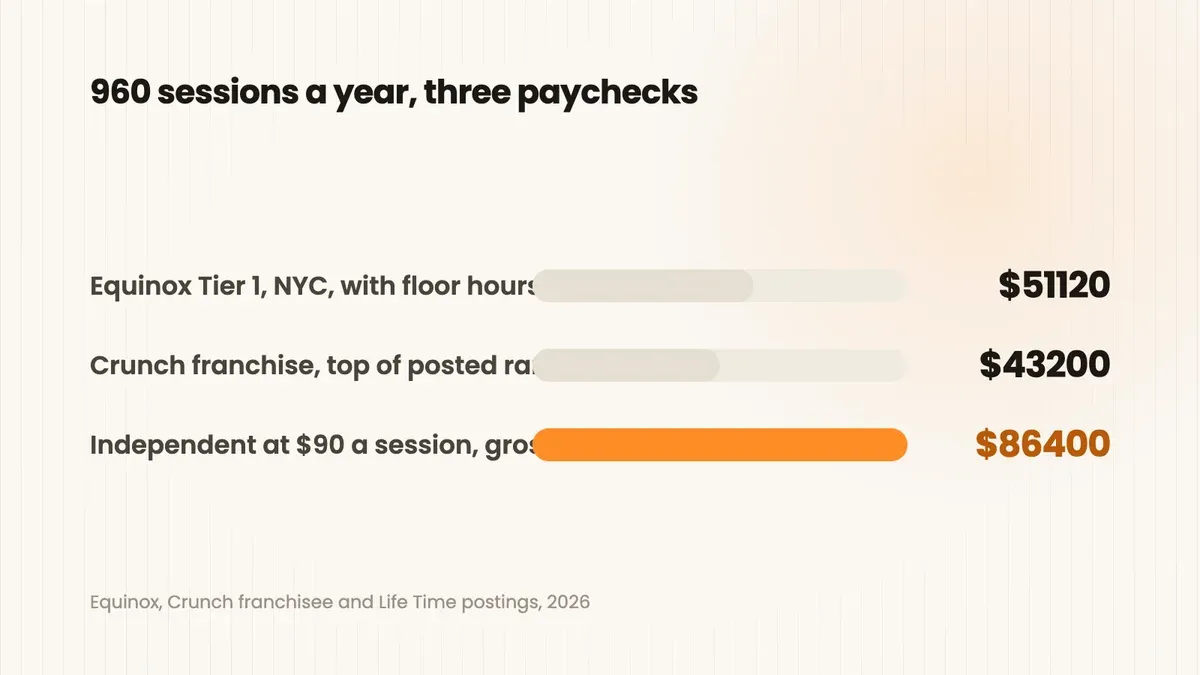
The break-even is the useful number. To match the $51,120 Equinox year at $90 a session you need 568 sessions, which is 12 a week, which is six clients training twice a week. Every client past those six is the raise the club was never going to give you. Redo it with your own club's member price and your own floor rate; the arithmetic is the same.
Five things to get in writing before you sign, or at your next review:
- What share of their scheduled hours the club's trainers billed last month. That one number turns the posted rate into your real hourly.
- What moves a tier: the sessions per pay period, the tenure, and how many of the club's trainers currently sit on the top one.
- Whether you are an employee or a contractor, and who pays the liability insurance. Employee status at Crunch's Florida franchise is in the posting; elsewhere, ask.
- What the club charges a member for one session. Your rate divided by that price is your split, and it tells you exactly what the club is keeping for the room, the pipeline and the brand.
- Who owns the relationship when you leave. A non-solicitation clause changes the break-even above, because the six clients have to be new ones.
When the split stops paying for itself
None of this makes the club a bad deal on day one. The split buys a room, a member pipeline and a name people already trust, and in your first year those are worth more than the half you give up. The deal turns when the pipeline stops being the club's and starts being yours: when the members on your schedule are there because of you and would book you anywhere. At that point the split is a percentage on your own retention.
So count them. Go through your schedule and mark every client who would follow you at your club's own member price. If the number is six or more on the Equinox math above, the independent year already matches the club year, with fewer hours. Most trainers who leave do not jump; they go hybrid, keeping the club shifts while a handful of clients train with them directly on the club's quiet days. The software built for in-person and hybrid trainers is designed around exactly that schedule, and the transition is a lot calmer than a resignation.
The client who follows you out of the club is used to one thing there: the front desk took the card, and you trained. Billing them yourself should feel that simple on their side. They pay the way they pay for anything else, and their sessions, their program and their check-ins sit in one place that opens in a tap, rather than one of the old-school coaching apps that take 20 clicks to log a workout. That is what Gymkee's client billing does for them, and you can run it free for 14 days, with no card needed.
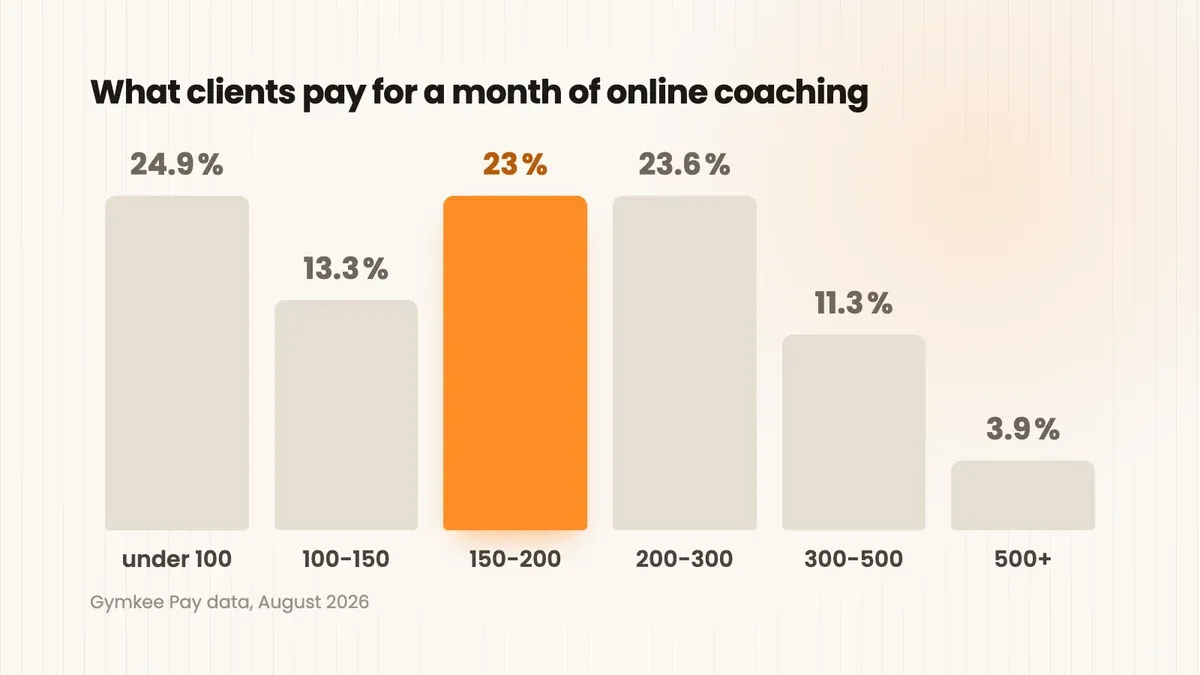
The online route changes the ceiling rather than the split. Trainers who coach clients virtually reported an average of $52,518 a year against $34,585 for in-person only (PTDC, 2021). That is a self-reported survey of 837 trainers, a direction, not a promise. On the pricing side, monthly coaching subscriptions billed through Gymkee, across every market Gymkee bills in, carry a median price of $175 a month, with the middle half of subscriptions between $104 and $245 (Gymkee Pay data, August 2026). A trainer with those six followers on a monthly plan is earning as an online trainer on a schedule no club can restrict.
Run the break-even with your own club's price before your next review, and keep the sheet: it is the same calculation whether you stay, go hybrid or leave.
FAQ
How much do Equinox personal trainers make?
In 2026 Equinox posts $40.50 to $98 per session in New York, $40.50 to $72.50 in San Francisco and Chicago, and $39.50 to $70 in Los Angeles, with non-session hours paid at $17 to $19.61 an hour depending on the city (Equinox job postings, 2026). Where you sit in that range is your tier, and your yearly income is the tier rate multiplied by the sessions you bill, plus the floor hours at the lower rate.
How much do Crunch Fitness personal trainers make?
Crunch corporate publishes no range. Its franchise owners do: a Massachusetts club posts $34 to $45 an hour with a three-tier percentage split that rises with sessions serviced, and a Florida club posts $29 to $63 an hour for private sessions with trainers as employees (Crunch Fitness franchisees, 2026). Each club is a separate employer, so ask for the sheet at the club you are applying to.
What does LA Fitness pay personal trainers per session?
LA Fitness does not post a pay range that can be verified, and every figure circulating online for it is a self-reported review. The structure is a per-session rate plus floor hours at a lower rate. Before you sign, get three things in writing: the session rate, the floor rate and how long a session runs, since some clubs pay per 25-minute slot.
Does Planet Fitness pay trainers for personal training sessions?
No. Planet Fitness runs PE@PF, free small-group instruction included in the $15 Classic Card membership (Planet Fitness, 10-K, 2026), and its trainers are employed by the franchisee on an hourly basis. There is no one-on-one session revenue to split, so it is a floor job with a trainer title rather than a way to build a client book.
Which gym pays personal trainers the most, and is independent better?
On posted figures, Equinox's top tier in New York, $98 a session, is the highest rate any major chain publishes, and Life Time's own rate card works out to roughly $45 to $72 a session for a full-time trainer (Equinox, 2026; Life Time, 2023). An independent trainer charging $90 a session keeps all of it before costs, and on the math above matches a full Equinox Tier 1 year with six clients training twice a week. The club is the better deal until those six clients are yours.