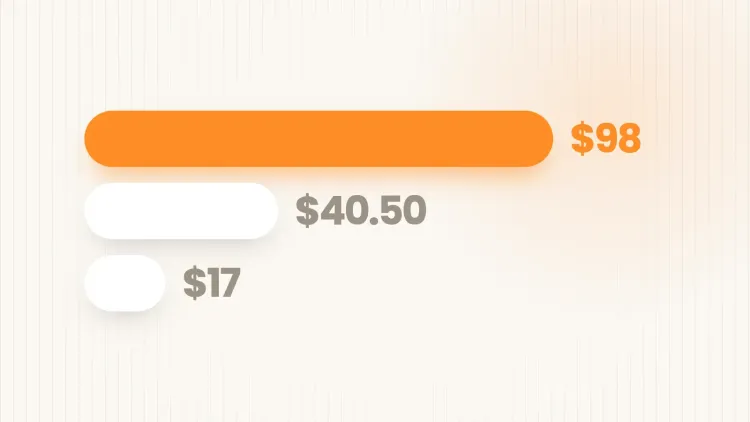
You get more personal training clients without ads by making your current clients the pipeline: a referral ask built into your check-ins, a free Google Business Profile collecting their reviews, and two or three local partners sending you people every month. Referred clients are worth at least 16% more and stay longer (Goethe University Frankfurt and the Wharton School, 2011).

Where your next ten clients are hiding
Before you write another post, run the four-minute audit almost nobody runs. Write down the last ten people who paid you and, next to each name, where that person actually came from: a client who introduced them, someone who saw you on the gym floor, a physical therapist, a comment on a post, a Google search.
Most trainers stop halfway down, because the pattern is already obvious: the names cluster around people who were one step away from somebody you already knew, while the audience of strangers you keep posting for almost never produces a name.
Jordan coaches at a big-box gym in Denver. Last winter he had six clients and was spending $400 a month boosting Instagram posts, which brought him one inquiry in three months, and that inquiry never booked.
When he ran the audit, five of his six clients traced back to two people: a former coworker who sent her husband, and a client who brought a friend from her running group. He stopped the boosts in January, built the three systems below, and finished the spring with fourteen clients.
None of that is specific to Denver. 88% of people say they trust recommendations from people they know more than any other channel (Nielsen, 2021), and buying reach does not change that ranking.
The money points the same way. A German bank tracked around 10,000 customers for 33 months and compared the ones who arrived through its referral program against everyone else, matched on age and join date.
The referred customers were worth at least 16% more and stayed longer, with the retention gap holding steady over time, not fading (Goethe University Frankfurt and the Wharton School, 2011). Banking is not coaching, and that pattern turns up wherever somebody has to trust a person before handing over money.
So the job is not finding strangers. It is building three systems on top of the clients you already train.
Turn the clients you have into a referral system
Most referral asks fail on timing rather than wording. A client three weeks in is still deciding privately whether you were worth the money, so asking them to recommend you puts them somewhere uncomfortable. The same client in the week they finally deadlift their bodyweight is already telling other people about it without being asked.
Here is what that sounds like on an ordinary Monday. Priya sends her check-in: the top set felt easy, her office chair is still wrecking her lower back, and her coworker has complained about the same thing for months.
Most trainers answer the first two points and let the third one go. That sentence about the coworker is a client telling you there is somebody in her life with the exact problem you fix all day.
The reply takes one line and asks Priya to sell nothing: "That is the same thing we sorted out for you. Send her my way if she wants, and I will do a free trial session so she can see what it involves." Priya forwards it that afternoon, because it costs her nothing and it makes her look useful to a coworker.
Waiting for those sentences is luck, so build the ask into a rhythm you already keep. Once a quarter, in the workout right after a client hits something they are proud of, say the same thing to five people: "I am opening two spots in October and I would rather fill them with people like you. Who do you know?" Two spots works because it is finite and specific: the client fills a real gap instead of being asked to promote you forever.
If your follow-ups are already written down, these check-in messages are where the question belongs, so it stops depending on whether you remember.
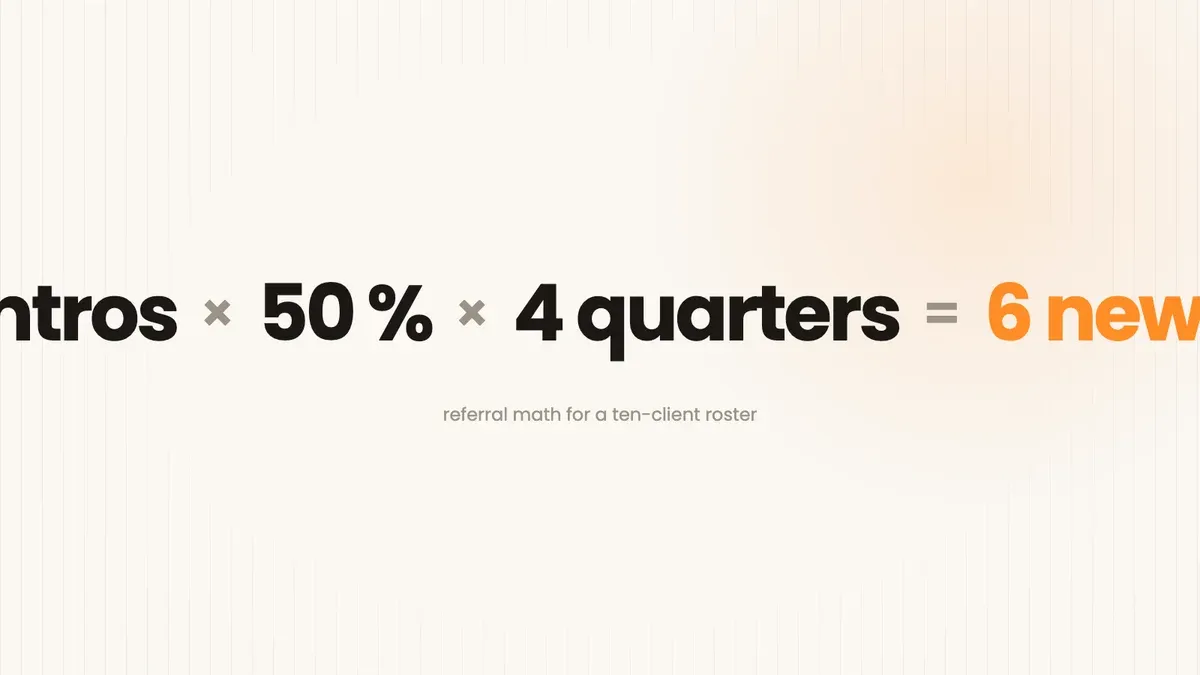
Now run the arithmetic on your own roster. Say you carry ten clients and you ask each of them once a quarter.
Say three of the ten give you a name, and lower that to two if you want to be careful.
Say half of those sign, which gives you one and a half new clients a quarter, six across the year.
At the median monthly coaching subscription billed through Gymkee Pay, $175 (Gymkee Pay data, August 2026), those six are worth around $1,050 a month of new recurring income by the end of that year.
For comparison, trainers on Gymkee billing in euros charge a median of 150 € a month.
Redo it with your own numbers, because the shape matters more than the total. Jordan's $400 a month bought one inquiry that went nowhere.
Own the map: your Google Business Profile and reviews
A Google Business Profile is free. It is also open to businesses that travel to their customers instead of working from a storefront, which covers every trainer doing in-home and outdoor work (Google, 2026). Setting one up takes an evening, and it is the only asset here that works while you sleep.
It matters because of where people check you out. 97% of US consumers read online reviews for local businesses, 71% use Google to evaluate one, and 68% will only consider a business rated four stars or higher (BrightLocal, 2026). Priya's coworker is going to search your name before she messages you, and what she finds decides whether that message ever gets typed.
Fill it out; a claimed profile left empty does nothing for you. List what you actually sell in plain words, add photos of the spaces you train in rather than stock barbell images, put your service area in, and connect a booking link so somebody at eleven at night can book themselves in.
Then collect reviews on purpose. The ask works in the 24 hours after a client does something they are pleased with, in person, while the feeling is still attached to the event. Tell them what to write about, because "could you leave me a review" produces four generic words and "could you mention the shoulder, since that is what you came in for" produces the review that sells the next person with a bad shoulder.
Three reviews put you in the conversation, ten make you the obvious choice in your neighborhood, and one a month from your existing roster gets you there.
Partners who send you clients every month
Physical therapists have the problem you solve. A patient finishes rehab, gets cleared to load, and has nowhere sensible to go, so the therapist watches good work unravel over the next two months. You are the answer to that, and almost nobody walks in and says so.
Walk in with an offer instead of a business card: an 8-week return-to-running block for patients coming off an ankle or a knee, starting at the load they were discharged at, with the therapist's restrictions written into it. Ask for one patient, which is a favor a therapist can say yes to without staking their reputation on a stranger.
What you send back makes it happen again. Once a month, for every shared client, send the therapist a two-line progress note: what the client is loading now and what still bothers them. It takes three minutes, tells a professional their referral was not wasted, and almost nobody does it: that is why these arrangements usually produce one client and then go quiet.
The same shape works elsewhere. A running club needs somebody to talk about strength work before a Saturday run, a chiropractor sees the same desk-related backs you do, and an HR manager at a hundred-person company has a wellness budget and nobody to spend it with. Pick two, not eight, and stay in front of them.
Partners refer with far more confidence when they can describe you in one sentence. "She trains runners coming back from injury" travels; "he is a great trainer" does not, which is the practical argument for committing to one of the profitable personal training niches rather than staying open to everyone.
Starting from zero: your first ten clients
With no clients you have no referral engine yet, so the first ten come from two networks you already sit inside.
The first is the people who did your certification with you. A NASM, ACE or ISSA cohort scatters across a dozen gyms, and those trainers get inquiries they cannot take: wrong schedule, wrong goal, wrong side of town.
Tell four of them exactly who you want, and you become the person they think of when they have to turn somebody away. Reading from the UK, Canada or Australia, swap in your own qualification and the mechanism is identical.
The second is the gym floor, which only works if you are useful before you are for sale. Spot somebody struggling, fix one thing, walk away without a pitch. Do that for a few weeks and people start asking what you charge, which is a better conversation than the one that starts with you interrupting a set.
Every one of those conversations should end at the same place: a free trial session with a date on it. Not a consultation, not a coffee, a real workout where the person feels what your coaching is like and you find out whether you can help them. The ones who say yes to a date are worth your effort, and the ones who will not commit were never going to sign a month later.
As for how long this takes, anybody quoting a number is guessing. It depends on how many people already know what you coach, how many real conversations you have each week, and how well your trial session converts. A trainer with a local network fills faster than one who just moved cities, on identical effort.
Make the experience worth talking about
Every system above puts your name in somebody's mouth, and what happens next depends on what your clients experience between workouts. The most common reasons personal training clients quit show up weeks before the cancellation, and a client who is quietly drifting is not going to introduce you to anyone.
The test is simple enough to run in your head. Can your client explain in one sentence what you do for them, do they see progress they did not have to take on faith, and is there anything about working with you they would actually show somebody?
That last part is usually a screen. Priya opens her Gymkee app and the whole thing is in one place: today's workout with a video on the exercise she has never done, her check-ins, the numbers moving over the last eight weeks.
That is what she turns around and shows her coworker at lunch, a very different object from an old-school coaching app that takes twenty clicks to find Tuesday. Keeping that experience identical across ten or twenty people is the real work, which is what client management has to take off your hands so these systems have something worth recommending underneath them.
Take one thing from here and do it this week. Send the two-spot sentence to five clients, or claim the Google profile and ask three people for a review before Sunday, and run your own roster inside Gymkee while you do it: 14 days free, no credit card.
FAQ
How long does it take to get clients as a new personal trainer?
Nobody can give you a number that means anything, because the timeline is driven by three things you control differently: how many people already know what you coach, how many real conversations you have each week, and how many of your trial sessions turn into paying clients. A trainer with a local network fills faster than one who just moved cities, on identical effort.
Should I train people for free to get my first clients?
Free trial sessions, yes. Free coaching for weeks, no. A single trial session with a date on it lets somebody feel your coaching before they pay, and it costs you one hour. Open-ended free work teaches the person that your time has no price, and it fills your calendar with people who were never going to buy.
Do I need Instagram to get personal training clients?
No. Instagram is useful as the place people check after somebody recommends you, so it should exist and look like you. It is a poor first channel because it asks strangers to trust you at scale, which is the slowest way to earn trust. Referrals, reviews and local partners do the same job with people who are already halfway there.
How do I ask for referrals without sounding desperate?
Ask after a win, not when your calendar is empty, and make the ask finite. Two spots opening next month is a real gap somebody can help you fill, while asking clients to spread the word gives them nothing to do. Offer their friend a free trial session so your client is handing over something useful rather than a sales pitch.
Is a referral discount worth it?
Usually not the way trainers use it. Discounting your own client's rate for every introduction quietly cuts the income of your most loyal people and teaches them your price is negotiable. A free trial session for the person they introduce works better, because the value goes to the newcomer and your existing rates stay where you set them.