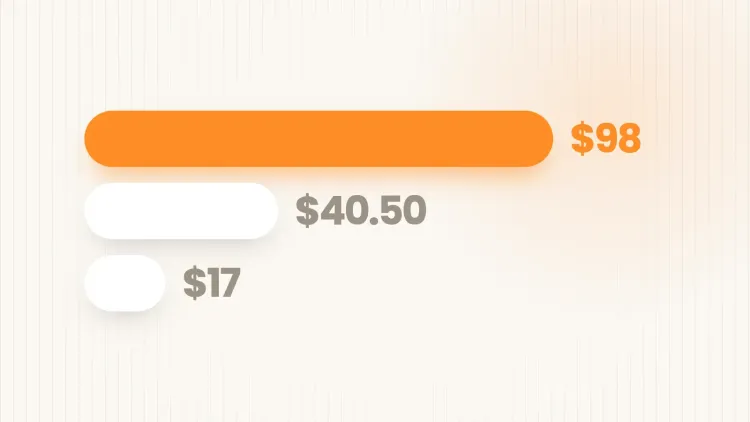
Most online personal trainers in the US charge between $100 and $500 per client per month (PTDC, 2025). Where you land in that range comes from two numbers you control: the hours you spend per client each week, and the hourly income you want each of those hours to earn. Multiply them, then build three tiers around the result.
What online personal trainers charge in 2026
The bottom of the range is thin on purpose: a template program and a monthly written check-in, with no messaging in between. The top is a different job. Custom training and nutrition built around one person, a weekly video check-in, and messages answered the same day. Two coaches with the same certification can sit at opposite ends and both be priced right, because they're selling different amounts of attention.
Where does the range come from? PTDC's figure is guidance from an organization that trains online coaches, so treat the edges as soft and the middle as the market. Nutrition coaching adds a second reference point for the low end: Precision Nutrition's coach survey, updated in 2023, puts $100 to $200 a month as the common starting point for a nutrition client. Read it as the floor of the market, and a nutrition floor at that, which is why the next section builds your number instead of borrowing one.
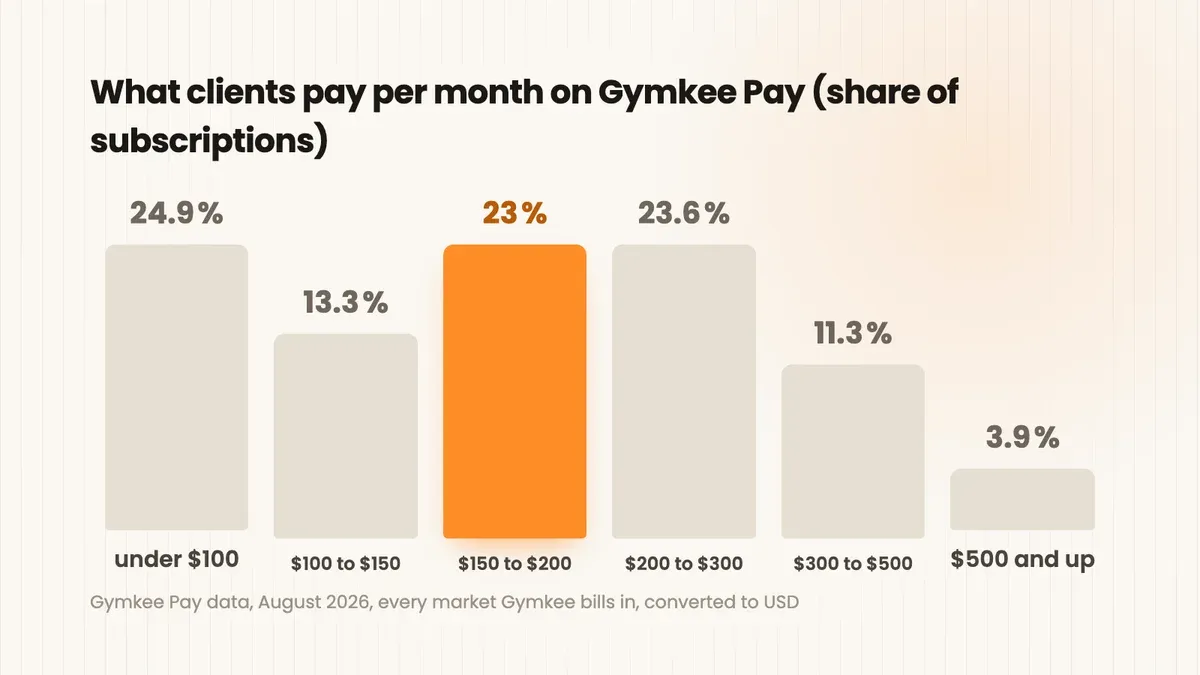
One number no survey has is what clients actually pay on Gymkee Pay. Across active monthly coaching subscriptions in every market Gymkee bills in, trainers on Gymkee charge a median of $175 a month, with the middle half of subscriptions sitting between $104 and $245 (Gymkee Pay data, August 2026). A quarter of subscriptions run under $100, about half sit between $150 and $300, and roughly one in seven is above $300. For comparison, trainers on Gymkee outside the US, most of them in Europe, charge a median of 150 € a month, with a similar spread. So the published $100 to $500 range is real, and on both sides of the Atlantic most coaches live in its lower middle; the ones above $300 are selling something visibly different.
Most pricing pages skip this next part. There's no large US survey that measures monthly online rates the way the Bureau of Labor Statistics measures wages. The figures above are the best that exist, and your own market matters more than any table, so the rest of this guide builds your price from your own numbers.
Why you price the month, not the workout
Charging per workout made sense in a gym. You had an hour, the client had an hour, and the hour was what you sold. To earn more you filled more hours or raised the rate, and that structure has a ceiling. The Bureau of Labor Statistics shows where it sits: the median wage for fitness trainers and instructors was $46,180 a year in May 2024, and most of that group is paid for hours delivered.
Online coaching breaks the ceiling because the hour stops being what you sell. The client buys a month of attention. A program built around their week. A check-in reviewed before it goes stale. A message answered before they talk themselves out of Tuesday's workout. A time slot is worth an hour. 30 days of someone watching their training is worth more, and the client already knows it.
You can see the difference in trainer income. PTDC's 2021 salary survey of 837 trainers found online coaches averaged $52,518 a year against $34,585 for trainers who stayed in-person only, and 86% of the six-figure trainers in that survey coached online. The data is five years old, so read it as the shape of the market and go find this year's number in your own niche.
Online coaching is also still a minority of the industry. Insurance Canopy's 2024 report on 4,132 insured trainers found only 28% work full-time and just 14.85% run online or virtual training. Most of the field still sells hours inside a gym, which leaves the monthly model to the coaches who set it up properly.
How to calculate your floor price (worked example)
Put the benchmarks aside for a minute. Your floor comes from your own hours and your own target, in four steps.
- Count your real minutes per client per week. Program updates, check-in reviews, messages, maybe a short call. When that work runs through a client app, it compresses; when it runs through a spreadsheet and a group chat, it doesn't. A workable starting assumption for a coach using a client app is about 1 hour per client per week. It's an assumption, so time yourself for two weeks and replace it with your number.
- Pick your hourly target. Take what you charged for an in-person hour as a certified trainer (NASM, ACE or ISSA) and carry it over. This example uses $60.
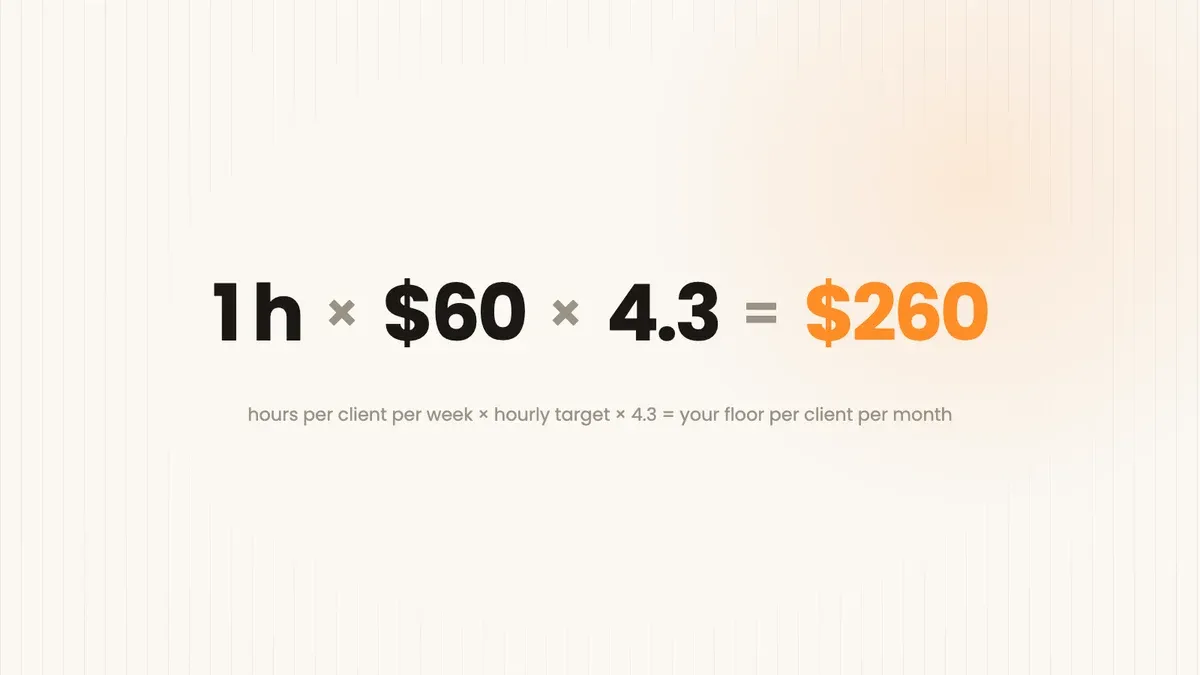
- Build the floor. 1 hour × $60 × 4.3 weeks in a month comes to about $260 per client per month. The formula holds for any inputs: hours per week × hourly target × 4.3 = your floor.
- Check it against a full roster. 20 clients at $260 is $5,200 a month, or $62,400 a year, before taxes and before software. Revenue and a wage aren't the same thing, but 20 clients already clears the $46,180 median for the whole industry.
Whatever you do, don't discount your way to a full roster. Every client below the floor costs hours you cannot bill, and those hours are exactly the ones you need to serve the clients who pay full price. Keep the sheet where you did this math, because you will come back to it the first time someone asks for a deal.
Three tiers that let the client choose
A single price asks the client one question: yes or no. Three tiers change the question to which one, and most people find the second question easier. No credible survey measures that lift, so treat it as reasoning and be wary of pages that sell it as data.
Tiers only work when each one is a visibly different product. Here's what changes between them:
| Deliverable | Starter | Coaching | Premium |
|---|---|---|---|
| Training program | Template | Custom, updated every 2 weeks | Custom, updated weekly |
| Nutrition | General guidelines | Personal macros | Custom meal plan |
| Check-in | Monthly, written | Weekly, written | Weekly, video |
| Messaging | None between check-ins | 24-hour reply | Same-day reply |
| Progress tracking | Client self-reports | Coach-reviewed | Coach-reviewed, with adjustments |
| Habit coaching | Not included | Basic | Full |
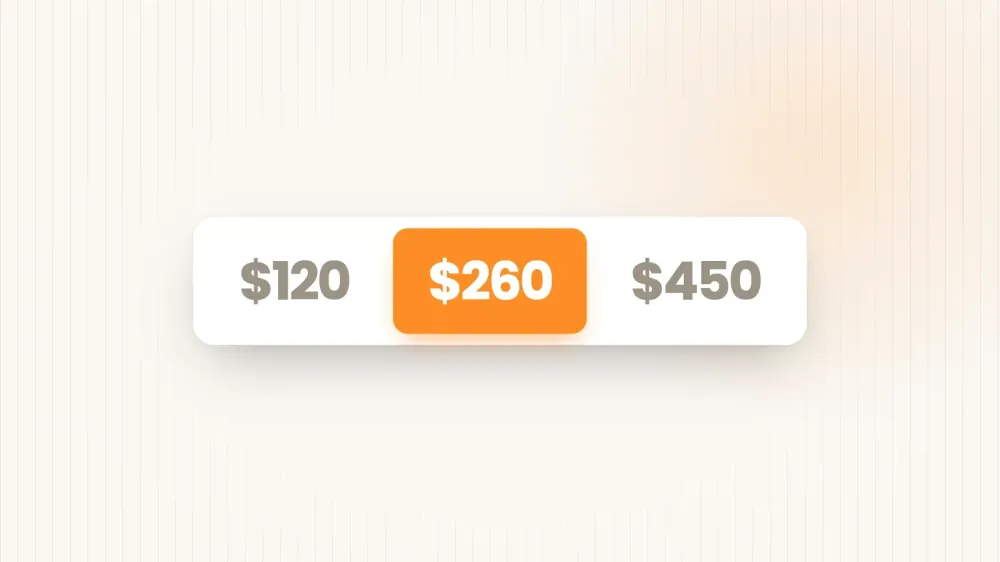
Now price the three columns off the $260 floor from the last section:
- Starter, $120 a month. A template program and a monthly check-in take about 15 minutes a week, so its own floor is 0.25 h × $60 × 4.3, about $65. You price it at $120 because the template is built once and reused across every Starter client, and because $65 attracts the wrong people.
- Coaching, $260 a month. Sits exactly on your floor. This is the tier you want most clients choosing, so it has to cover your number.
- Premium, $450 a month. Custom nutrition, a video check-in and same-day replies run closer to 1.75 hours a week: 1.75 h × $60 × 4.3 comes to about $450. Run the same formula for your own three columns and the whole table becomes yours.
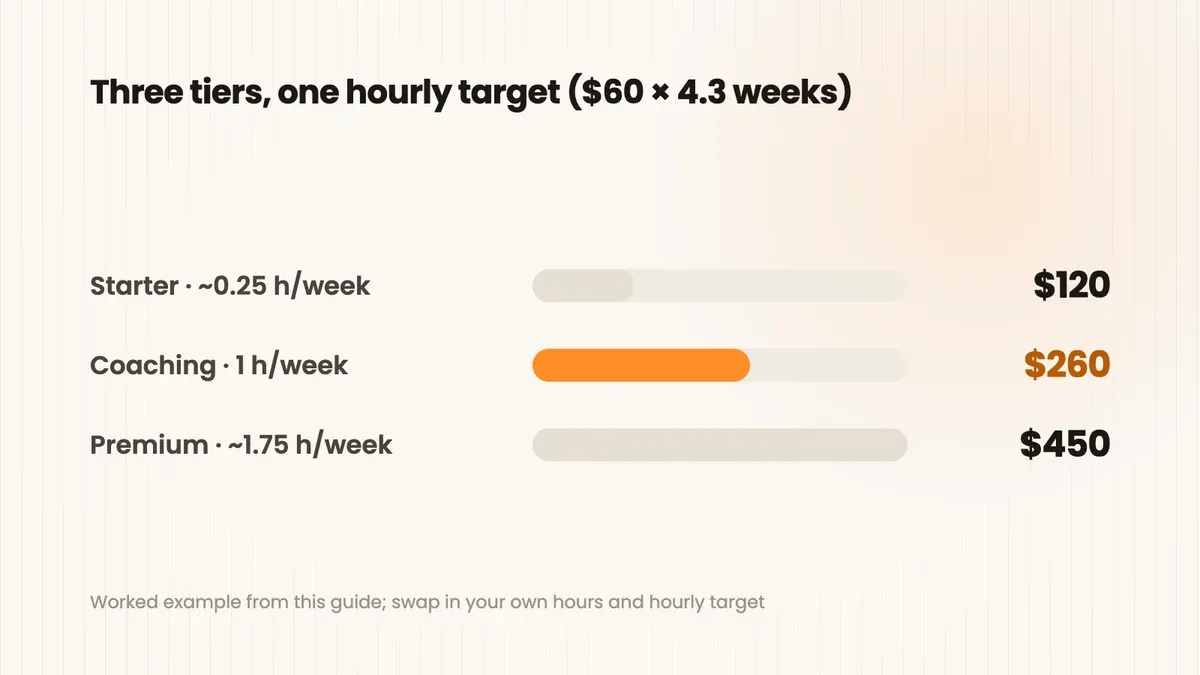
Starter and Premium exist to frame Coaching as the obvious middle ground. A few clients will still pick the ends, and that's fine. What fails is the same coaching with three price tags stapled on.
Why your tiers only hold if the client can see them
Take a coach who raises her rate to $260 in January but leaves the eleven people she already has at $150, because they were there first and it feels wrong to touch them.
By June she is running two businesses out of one calendar. The $150 group takes the same hours as the $260 group, so the more her roster grows the closer her average slides back to where it started, and every new client she signs at full price knows someone paying less. Grandfathering felt like loyalty; it priced the next twelve months for her.
Delivery decides whether the tiers hold up. Inside a spreadsheet and a group chat, three tiers look like three prices for the same messages, and a client scrolling back through the chat to find last week's workout doesn't feel like they're paying $260 a month for anything.
Look at what a new client sees in their first week instead. Day one, Coaching: the program is already there with videos, the check-in is scheduled, and the first message asks about their old injury before they train, not after. Day one, Starter: the program is there and nothing else is, because that is what the tier includes. Neither client has to be told what the difference costs; they watch it happen in the first seven days, which is exactly when people decide whether to stay.
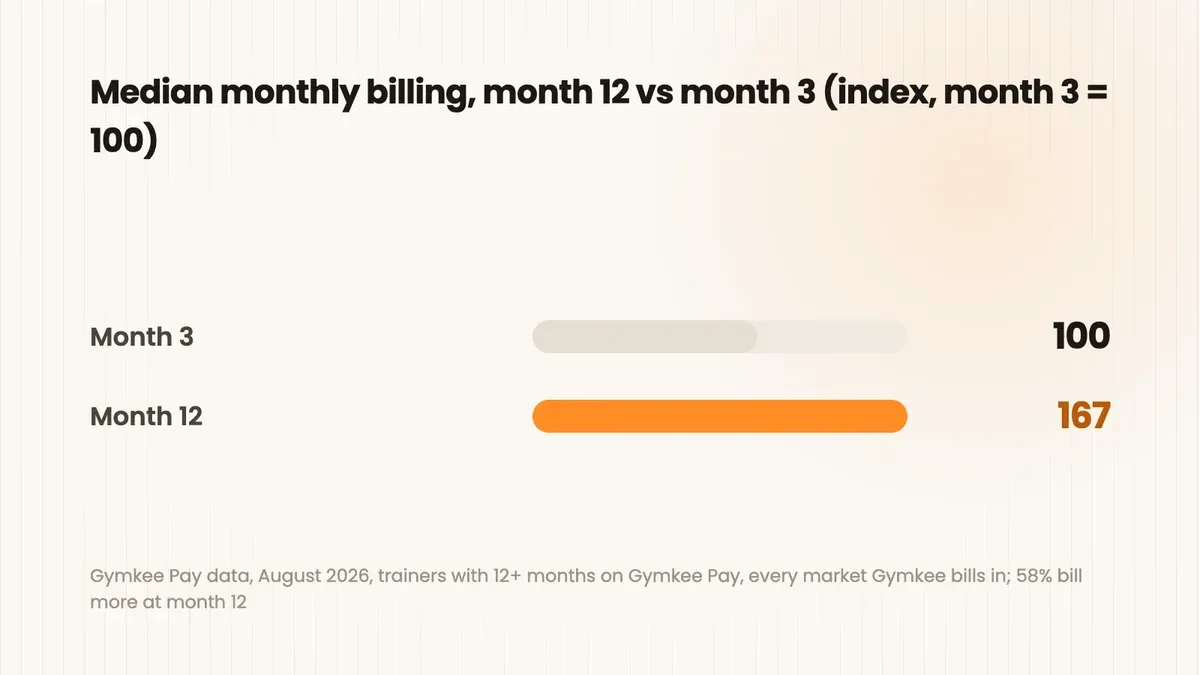
For the coach, that's the moment three tiers stop being a spreadsheet and become a real product delivered through an app for personal trainers. Old-school coaching apps that take 20 clicks to reach a workout can't give a client that Sunday. It shows in the billing, too: among trainers whose first Gymkee Pay invoice is at least a year old, in every market Gymkee bills in, median monthly billing at month 12 is about two-thirds higher than at month 3, and 58% of them bill more (Gymkee Pay data, August 2026). The figures can't separate a fuller roster from higher prices, and they don't prove that Gymkee caused either; our reading is that a product the client can see makes both easier.
Try Gymkee free for 14 days, no credit card required.
Monthly, fixed-length or hybrid: which structure fits
The monthly tiers above fit most coaches. Two other structures use the same floor.
Monthly coaching. A flat fee, billed automatically every month, for ongoing programming, check-ins and messaging. Predictable income, and the relationship compounds. The cost is consistency: the check-in has to land every week, month after month.
A fixed-length program. Eight or twelve weeks with a defined outcome, like a first marathon or a body recomp. Price it as your monthly floor times the number of months, paid up front or in installments. It sells well when the outcome is specific, and it forces a renewal conversation when the program ends. Build the next step into week ten, before the client starts wondering what happens next.
Hybrid coaching. Online coaching as the base, plus one or two in-person workouts a month for form checks or a hard day together. Price it as your monthly floor plus your in-person hourly rate times the workouts included. It earns the most per client, since the client gets convenience and face time, and it limits you to clients who can reach you.
Whichever structure you choose, the floor stays the same number. The structure only changes how the client pays, so pick the one you can deliver every month without dreading it.
Check your rate against your market, then launch
Before you publish a number, price the alternative your client is actually weighing. A gym membership plus four in-person sessions a month lands near $300 in most US cities, and it buys them four hours of attention and nothing in between. Put your monthly next to that, with what happens on the other twenty-six days, and the number stops being compared to a coach's Instagram bio and starts being compared to what the client would otherwise spend.
Then pick a first price you can defend in one sentence when a prospect pushes back. A price that makes you flinch when you type it gets undercut in the first sales call. A low first price costs more than money, too: it attracts clients who are testing you, and once they're used to that number, raising it later costs you the relationship along with the discount.
When your roster is full at your floor, the next move is to raise your personal training prices without losing clients. Discounting your way to a bigger roster only lowers the floor you built in section three, and if a flat monthly fee doesn't match how you coach, 7 ways to price your personal training services walks through the other models, including packages, hourly, and hybrid retainers.
Mo laid out the reasoning behind pricing the month instead of the hour in a 2022 video on online coaching pricing. The floor method in this guide started there.
FAQ
Is $200 a month good for online personal training?
It sits inside the sourced $100 to $500 per month range (PTDC, 2025) and above the $100 to $200 entry point measured in nutrition coaching (Precision Nutrition, 2023). Whether it's good for you depends on your floor. If your hours and hourly target put that floor near $260, $200 is below it, and you'd be paying to coach every extra client.
How much should I charge for online personal training as a beginner?
Start from your own floor. Count your real hours per client per week, pick an hourly target your certification supports, and multiply by 4.3 weeks. At 1 hour and $60 an hour, the floor is about $260 a month. Charging less to win your first clients usually costs more in hours than it earns in signed clients, and it's hard to raise later.
Should I charge per workout or per month for online coaching?
Per month. Online coaching is a program, weekly check-ins and messaging spread across four weeks, so a per-workout price ignores the work between workouts. It also keeps you under the hourly ceiling: the Bureau of Labor Statistics puts the median wage for fitness trainers at $46,180 a year (May 2024), while PTDC's 2021 survey found online trainers averaging $52,518.
How many online clients can one trainer handle?
There's no fixed number. If each client takes about an hour a week and full-time coaching means 30 to 40 hours a week (Precision Nutrition, 2023), that's roughly 20 to 25 clients once you keep time for admin. Twenty clients at a $260 floor is $5,200 a month. Adding clients past your hours without raising prices first is what burns coaches out at the roster size that should pay them the most.
How do I justify a higher online coaching rate?
Show what's included and how it's delivered. List the deliverables of each tier so the gap between $120 and $450 is visible on the page, then make sure the client feels that gap every week: the Premium client should get their video check-in and same-day reply without ever having to ask. The rate justifies itself when the client can point to what they got this month; it never does when they have to remember.